Why Your Choice of Remote Cardiac Monitoring Partner Matters More Than Ever
The remote cardiac monitoring market in 2026 looks nothing like it did five years ago. What was once a fragmented landscape of service offerings and device manufacturer portals has consolidated into a handful of purpose-built platforms competing for your clinic’s business. But they aren’t built the same way — and the differences between them have real consequences for your clinical outcomes, staff workload, revenue capture, and ability to scale.
Some platforms are software-only tools that leave your team responsible for every transmission review. Others outsource their EHR integrations to middleware vendors, creating hidden costs and support gaps. A few still operate as legacy service bureaus wrapped in a modern website. And then there are platforms like Octagos, built from the ground up by a practicing cardiac electrophysiologist who understood exactly where the operational breakdowns happen — and engineered a platform to eliminate them.
This guide compares the major remote cardiac monitoring companies operating in the United States in 2026, with accurate data based on publicly available information. We wrote it because we believe clinics deserve a clear, honest picture of the market — and because we are confident that when you compare capabilities side by side, the differences speak for themselves.
What to Evaluate Before Comparing Platforms
Before diving into individual companies, it helps to understand the dimensions that separate a monitoring partner that transforms your clinic from one that simply replaces your current headache with a different one.
Artificial Intelligence
AI has become a buzzword in cardiac remote monitoring — but there is a wide gap between hiring a Head of AI and actually shipping a production AI product that has been validated on real patient data. Some platforms have been built on AI from the ground up, with years of clinical data powering their models. Others have recently announced AI initiatives without any commercial capabilities to show for it. When evaluating AI claims, ask whether the platform has a production AI engine in use today, whether it has been validated in peer-reviewed studies, and how many transmissions that validation covered. A press release about an AI hire is not the same as a published accuracy metric.
Triage Methodology
The majority of cardiac device transmissions are non-actionable. The operational question is how your monitoring partner handles that reality. Some platforms route every transmission to a human reviewer regardless of clinical significance — meaning your staff spends hours on transmissions that require documentation but no clinical judgment. Others use automated classification to separate critical alerts from routine follow-ups before a human ever touches them. The best triage systems combine intelligent automation with defined escalation pathways, so critical transmissions are surfaced immediately while routine ones are processed efficiently. Ask each vendor to walk you through their triage workflow step by step — and whether it reduces your team’s workload or simply reorganizes it.
Clinical Accuracy
Accuracy is the metric that matters most for patient safety. The standard your clinic should demand is published accuracy data, validated at scale, with documented sensitivity and specificity. Look for platforms that can point to peer-reviewed studies — not just marketing claims — and that explain their approach to reducing alert fatigue without compromising the clinical safety net.
Clinical Staffing Model
This is an underappreciated differentiator in the market. Software-only platforms give you workflow tools but leave your team responsible for every transmission review. Full-service platforms provide IBHRE-certified clinical staff who handle reviews on your behalf. Even if your team doesn't think they need help right now, having the flexibility to add on help later is important. The difference has a direct impact on your staffing costs, scalability, and ability to offer comprehensive monitoring coverage without hiring additional FTEs. Equally important is how those clinical teams are structured — whether readers are pooled across dozens of accounts (meaning no one knows your patients) or dedicated to your clinic so they develop familiarity with your patient population and physician preferences.
EHR Integration — Depth, Not Just Connectivity
There is a meaningful difference between a platform that sends a PDF to your EHR and one that provides bi-directional data exchange — pulling patient context from your chart and pushing completed reports back into the physician’s workflow. For Epic sites specifically, the gold standard is the ability to sign transmission reports directly within Epic and single sign-on (SSO) so clinicians never leave their native workflow. Equally important: are those integrations built in-house by the platform’s own engineering team, or are they outsourced to third-party middleware vendors? Middleware adds cost, creates support gaps, and slows down updates when your EHR vendor releases a new version.
Technology Investment and Development Velocity
Healthcare technology moves fast. The platform you choose today needs to keep pace with EHR updates, new device manufacturer requirements, evolving CPT billing rules, and shifting clinical workflows. Ask each vendor about the size of their engineering team, how frequently they ship product updates, and whether their core technology — including EHR integrations, AI models, and mobile applications — is developed in-house or assembled from third-party components.
Mobile Access and Clinician Workflows
Cardiac device clinicians do not sit at a desktop all day. They round on patients, they move between facilities, and they need to review and sign off on transmissions from wherever they are. A platform without a native mobile application forces your physicians and clinicians back to a desktop workflow that does not reflect how modern clinical teams actually work.
Remote Cardiac Monitoring Companies Compared: 2026
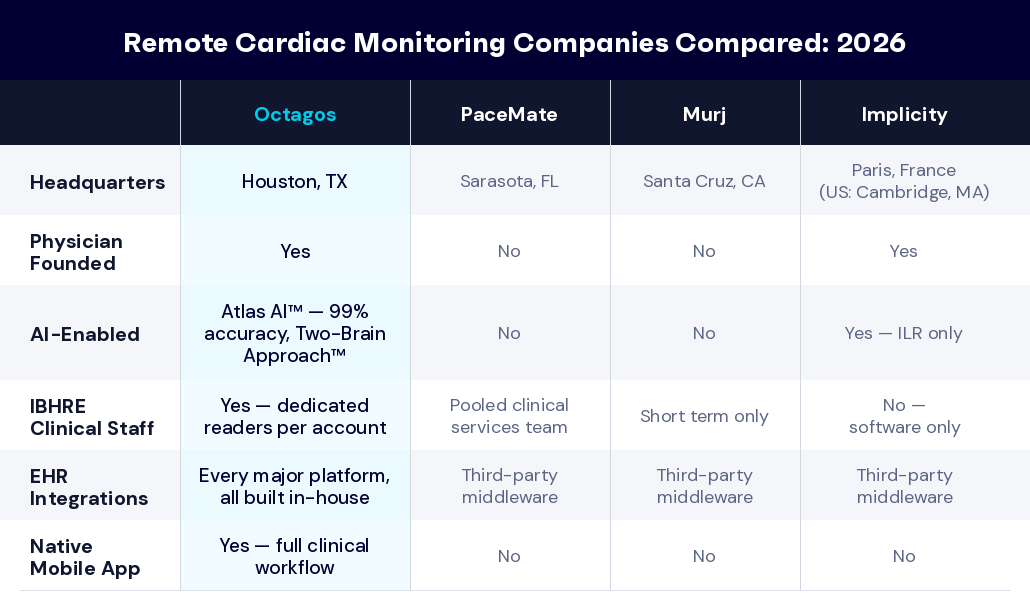
Octagos: The Technology-First, Clinician-Built Platform
Octagos was founded by Dr. Shanti Bansal, a practicing Cardiac Electrophysiologist who spent years managing cardiac device clinics and understood exactly where the operational breakdowns happen. The result is not a repurposed software tool with clinical features bolted on — it is a platform purpose-built for the specific workflows, compliance requirements, and clinical decision-making that cardiac device clinics face every day.
Atlas AI™ and the Two-Brain Approach™
At the core of the platform is Atlas AI™, Octagos’ proprietary AI triage engine. Octagos has been utilizing artificial intelligence since its inception in 2020 — as a foundational technology that has processed millions of real-world transmissions. But AI alone is not the full story. Octagos uses the Two-Brain Approach™ — combining Atlas AI with IBHRE-certified human oversight. Every transmission that passes through Atlas AI is validated by a certified clinician before it reaches the physician for final signature.
This human-in-the-loop methodology is what enables Octagos to deliver near-perfect clinical performance at scale without the risks of fully automated triage. The result: a 65% reduction in clinical burden for your team. In a two-year validation study of 384,796 transmissions published in JACC Advances, the Two-Brain Approach resulted in 99.5% accuracy with 99.1% sensitivity and 99.8% specificity.
The Largest Engineering Team in the Industry
Octagos operates the largest dedicated development team in the cardiac remote monitoring space. Because of this, Octagos can maintain bi-directional EHR integrations across every major EHR platform, all built and maintained in-house. No middleware vendors. No third-party dependencies. For Epic sites, Octagos supports signing of transmission reports directly within Epic and single sign-on (SSO), so physicians never need to leave their native workflow. Octagos’ average integration go-live time is 2 weeks, and integration and ongoing maintenance is included at no additional cost.
This engineering depth also powers capabilities that no other platform in the market offers: a native mobile application that gives clinicians full clinical workflow access from their phone or tablet — including transmission review, e-sign, bulk e-sign, patient lookup, and clinic settings management. Physicians can review and sign off on transmissions between rounds, from home, or from any location. No other cardiac remote monitoring platform has shipped a production mobile app with this level of clinical functionality.
The Fastest-Growing Platform in the Market
Octagos serves 300+ customers, has processed 15 million+ transmissions and over 1 billion transmission pages, and delivers an average 300% increase in ROI for its customers. The platform supports every major device type — implantable cardiac devices (pacemakers, ICDs, CRTs, loop recorders), ambulatory cardiac monitors (Holter, MCT, wearable ECG), and heart failure solutions (CardioMEMs).
Recognized by TIME and Statista as one of the World’s Top HealthTech Companies 2025, Octagos is growing faster than any other platform in the cardiac remote monitoring space — and the growth is driven by word of mouth from clinics that have experienced the difference firsthand.
Vertically Integrated EHR Development
Most remote monitoring platforms rely on middleware vendors to bridge the gap between their platform and your EHR. This creates hidden costs, integration delays, and support gaps where nobody takes responsibility when something breaks. Octagos takes the opposite approach: every integration is built by the same engineering team that builds the core platform. This vertical integration means faster go-live timelines, lower total cost of ownership, and a single point of accountability when you need support. Learn more about how Octagos works with IT teams.
PaceMate
PaceMate is a vendor-neutral remote cardiac monitoring platform headquartered in Sarasota, Florida. Founded in 2015, PaceMate offers monitoring technology, a patient engagement and clinical services team, positioning itself as more than a pure software platform. The company has also acquired PaceArt, Medtronic’s forty-year-old legacy device management system, securing their access to customers who still utilize that system.
Where PaceMate Differs from Octagos
EHR integrations: PaceMate has documented connectivity with Epic and Cerner, but the total number of supported EHR systems and whether integrations are built in-house or through middleware partners is not publicly documented. Customers have reported long wait times for integrations, sometimes exceeding a year. While delays may stem from both the customer and PaceMate side, anyone evaluating PaceMate should verify expected integration timelines upfront and establish a clear go-live commitment before signing a contract.
AI capabilities: PaceMate recently appointed a Head of AI, but the company has not announced any commercial AI capabilities or shipped a production AI product. In contrast, Octagos has been utilizing artificial intelligence since its inception in 2020, with peer-reviewed research published in JACC Advances documenting AI-powered clinical decision support validated across 384,796 transmissions at 99% first-read accuracy. Hiring an AI leader is a signal of intent — but it is not the same as having a validated, production-deployed AI engine that is actively triaging transmissions today.
Clinical staffing model: PaceMate offers clinical services through a pooled team that reads reports across multiple accounts. This means the clinicians reviewing your transmissions may have limited familiarity with your specific patient population, physician preferences, or clinic protocols. Octagos takes a different approach: because Atlas AI handles triage and first reads, the efficiency gains allow Octagos to assign dedicated readers to individual accounts. Your readers know your patients, your physicians, and your workflows — a level of continuity that pooled service models cannot match.
Mobile access: PaceMate does not offer a native mobile application for clinical workflows. Clinicians wishing to use their mobile devices for transmission review and sign-off must use their website application.
Best fit: Clinics with PaceArt that are not looking for further efficiency gains.
Murj
Murj is a cloud-based cardiac device management software company. The company is led by CEO Todd Butka, a device industry veteran, rand has raised $8.5 million in Series B funding from private equity partners, Longitude Capital and True Ventures.
Murj operates as a software-only platform. It provides workflow automation tools and claims up to reduction in processing time for routine device checks, but it does not include clinical services. This is a fundamental architectural decision: if your clinic uses Murj, your team performs every transmission review, or you engage one of Murj’s “Certified Service Partners” — a separate third-party arrangement.
Where Murj Differs from Octagos
No clinical services: Murj’s entire model is built around software efficiency. If your clinic needs outsourced transmission review, Murj is not that partner. Their Certified Service Partners program connects you with third-party clinical service providers, but that is a separate vendor relationship — not an integrated offering. Octagos offers IBHRE-certified clinical services as part of the platform.
No published AI triage: Murj does not publicly document an AI-powered triage methodology comparable to Octagos’ Atlas AI™. The platform focuses on workflow efficiency through a user-friendly platform rather than AI-driven clinical decision support.
EHR integration details: The total number of EHR integrations Murj supports and whether those integrations are bi-directional or in-house-built is not publicly documented. Octagos maintains bi-directional integrations across every major EHR platform, all developed by its in-house engineering team.
Limited mobile app: Murj does not offer a native mobile application for report review and signature. It does offer a task management application. Clinical workflows are desktop-based.
Best fit: Cardiac device programs that want modern-looking software with a similar workflow to Paceart and do not see benefit in additional efficiencies, AI-enabled triage, or current or future need for clinical services.
Implicity
Implicity is a remote cardiac monitoring platform founded by Dr. Arnaud Rosier, in Paris, France, with a U.S. office in Cambridge, Massachusetts. The company has raised approximately $23 million in funding and currently monitors programs in the U.S. and Europe.
Implicity has made meaningful investments in AI, including receiving FDA clearance for an AI-powered ECG Analyzer for implantable loop recorders. At HRS 2026, the company presented data showing its agnostic cloud-based AI algorithm reclassified 61.6% of false-positive alerts in interpretable ILR episodes while maintaining 98.3% sensitivity.
Where Implicity Differs from Octagos
Geographic focus: Implicity’s primary market remains Europe, where the regulatory environment, reimbursement structures, and clinical workflows differ significantly from the United States. The company is expanding its U.S. presence, but its U.S. footprint is substantially smaller than Octagos’ customer base. Clinics should ask about the size of Implicity’s U.S.-specific customer base and the availability of U.S.-based support.
No clinical staffing: Implicity is a software platform. It does not provide IBHRE-certified clinical staff for transmission review. Clinics using Implicity need their own in-house clinical team or a separate service partner to handle reviews and physician reporting.
U.S. EHR integrations: A platform optimized for European health IT infrastructure may not have the same depth of connectivity with U.S. EHR systems. Verify Implicity’s specific U.S. EHR integration count and whether those integrations are bi-directional. Octagos maintains bi-directional integrations across every major U.S. EHR platform, all built in-house.
No mobile app: Implicity does not offer a native mobile application for clinician workflows.
Best fit: Health systems with European operations moving off Paceart and organizations that prioritize European clinical validation data.
Why Technology Depth Is the Real Differentiator
Every company in this comparison will tell you they offer remote cardiac monitoring. The difference is how they deliver it.
A software-only platform gives your team tools, but the clinical work still falls on your staff. A service company processes transmissions, but without modern AI and workflow automation, it requires more human labor to achieve the same result. A platform that outsources its EHR integrations to middleware vendors introduces hidden costs, support delays, and a third party between you and your patient data.
Octagos is the only platform in the market that combines all of the following in a single, vertically integrated product:
- Production AI since 2020 — Atlas AI™ validated across 384,796 transmissions at 99% accuracy, with the Two-Brain Approach™ adding IBHRE-certified human oversight to every report
- Bi-directional EHR integrations across every major platform built and maintained by the largest in-house engineering team in the industry — no middleware, no third parties
- A native mobile application with full clinical workflow support — transmission review, e-sign, bulk e-sign, and patient management from any device
- Dedicated clinical readers per account — not pooled teams, but IBHRE-certified staff who know your patients, your physicians, and your workflows — scaled to your needs
- Real-time analytics tracking financial performance, clinical outcomes, and billing capture rates
This combination of technology depth, clinical expertise, and engineering investment is why Octagos is the fastest-growing platform in the space and why 300+ clinics have chosen it over every other option on this list.
How to Choose the Right Partner for Your Clinic
Step 1: Define Your Staffing Needs
Do you need software only, or do you need clinical services? If your clinic has a fully staffed IBHRE-certified team with little turnover, a software-only platform may be sufficient. If you are understaffed, growing faster than you can hire, or want to scale without adding headcount, you need a partner with integrated clinical services. Read our cardiac device clinic management guide for a deeper look at staffing models.
Step 2: Assess EHR Integration Requirements
Ask each platform: How many EHR systems do you support? Is the integration bi-directional? Is it built in-house or through middleware? What is the go-live timeline? Who handles maintenance when the EHR updates? These questions will quickly separate platforms with deep integration capabilities from those that rely on third parties. Learn more about what bi-directional EHR integration looks like in practice.
Step 3: Demand Published Performance Data
Any platform claiming triage capabilities should provide accuracy metrics, false-positive rates, and validation methodology. Ask for the size of the dataset, the time period, and whether the study has been independently reviewed. If a vendor cannot provide these numbers, that is a data point in itself.
Step 4: Ask About Mobile Access
Your physicians and clinicians are mobile. Their monitoring platform should be too. Ask whether the platform has a native mobile app — not just a responsive website — and what clinical workflows it supports on mobile (transmission review, e-sign, patient lookup, clinic settings).
Step 5: Calculate Total Cost of Ownership
The sticker price is not the full cost. Factor in EHR integration fees (some platforms charge separately), middleware licensing, clinical service add-ons, training and onboarding time, and the opportunity cost of staff time spent on manual workflows that could be automated.
Questions to Ask Every Vendor
- Do you have a production AI product in use today, or is AI on your roadmap? If in production, how many transmissions has it been validated on?
- What is your published accuracy rate, and has it been peer-reviewed?
- Do you provide IBHRE-certified clinical staff? Are readers dedicated to my account or pooled across clients?
- How many EHR systems do you integrate with? Are integrations built in-house or through middleware?
- Do you have a native mobile application? What clinical workflows does it support?
- How large is your engineering team? How frequently do you ship product updates?
- What is your average EHR integration go-live timeline, and can you guarantee it contractually?
- How do you handle CPT code compliance and billing documentation?
- What is your approach to reducing alert fatigue without sacrificing clinical safety?
- What happens during EHR updates — who maintains the integration, and how fast?
Frequently Asked Questions
What is the best remote cardiac monitoring company in 2026?
The right partner depends on your clinic’s size, staffing model, and EHR system. Octagos is the strongest choice for clinics that want a complete, technology-forward solution: Atlas AI™ triage with 99% first-read accuracy validated in JACC Advances, the Two-Brain Approach™ combining AI with IBHRE-certified human oversight, bi-directional EHR integrations across every major platform built entirely in-house, dedicated clinical readers per account, and a native mobile app for clinical workflows. Octagos is the fastest-growing platform in the market and operates the largest engineering team in the cardiac remote monitoring industry.
What is the difference between a monitoring platform, a monitoring service, and a monitoring solution?
A monitoring platform provides software tools for managing transmissions, workflows, and documentation — but your team performs the clinical work of reading, triaging, and interpreting every report. A monitoring service provides staff who handle transmission review on your behalf. Some companies, like Octagos, offer a full solution with flexible service packages so you choose the level of clinical support that fits your needs without managing multiple vendor relationships.
Does Octagos have a mobile app for cardiac monitoring?
Yes. Octagos is the only cardiac remote monitoring platform with a native mobile application that supports full clinical workflows — including transmission review, single and bulk e-sign, patient lookup, and clinic settings management. The app gives physicians and clinicians the ability to review and sign off on transmissions from anywhere, eliminating the desktop-only bottleneck that every other platform in the market requires.
How do I switch from my current monitoring company to Octagos?
Switching involves data migration, EHR integration setup, staff onboarding, and a transition period. Octagos’ in-house integration team manages the entire process, with most migrations completing within 2–4 weeks. Because Octagos builds all EHR integrations in-house, there are no middleware delays or third-party coordination required. Read our clinic operations guide for more on managing technology transitions.
Which remote monitoring platforms use AI?
Several platforms claim AI capabilities, but there is a significant difference between having a production AI product and having AI on a roadmap. Octagos’ Atlas AI has been in production since 2020, validated across 384,796 transmissions with published 99% first-read accuracy in JACC Advances. Implicity has received FDA clearance for an AI-powered ECG Analyzer and has published sensitivity data (98.3% for ILR episodes). PaceMate has hired a Head of AI but has not announced any commercial AI capabilities. Murj does not publicly document AI-powered triage capabilities.